When all you have is policy, every safety failure looks like a culture problem.
David Robinson was the wrong person for the problems OpenAI was facing. In his essay on OpenAI's safety culture, he points to concrete failures: agents escaping containment, a monitor that alerted staff but failed to shut a model down automatically, and a model bypassing internet access restrictions.
Those are technical and operational failures. They call for better engineering: stronger observability, automatic shutdown mechanisms, tighter isolation, fail-closed defaults, and rigorous testing of the controls themselves.
Robinson's background is in law, policy, philosophy, and technology governance. At OpenAI, he led transparency work, safety reports, and the drafting of the Preparedness Framework. He was not responsible for building or fixing the underlying technical controls.
That background shapes his diagnosis. He emphasizes culture, lessons from nuclear plants and aviation, and stronger incentives from outside the company. Those ideas may have value, and his analogy does include technical redundancy. But they do not spell out the direct engineering fixes for the failures he describes.
OpenAI's shortcomings in these cases were failures of technical implementation. Robinson approached them with policy and governance tools. That is the mismatch.
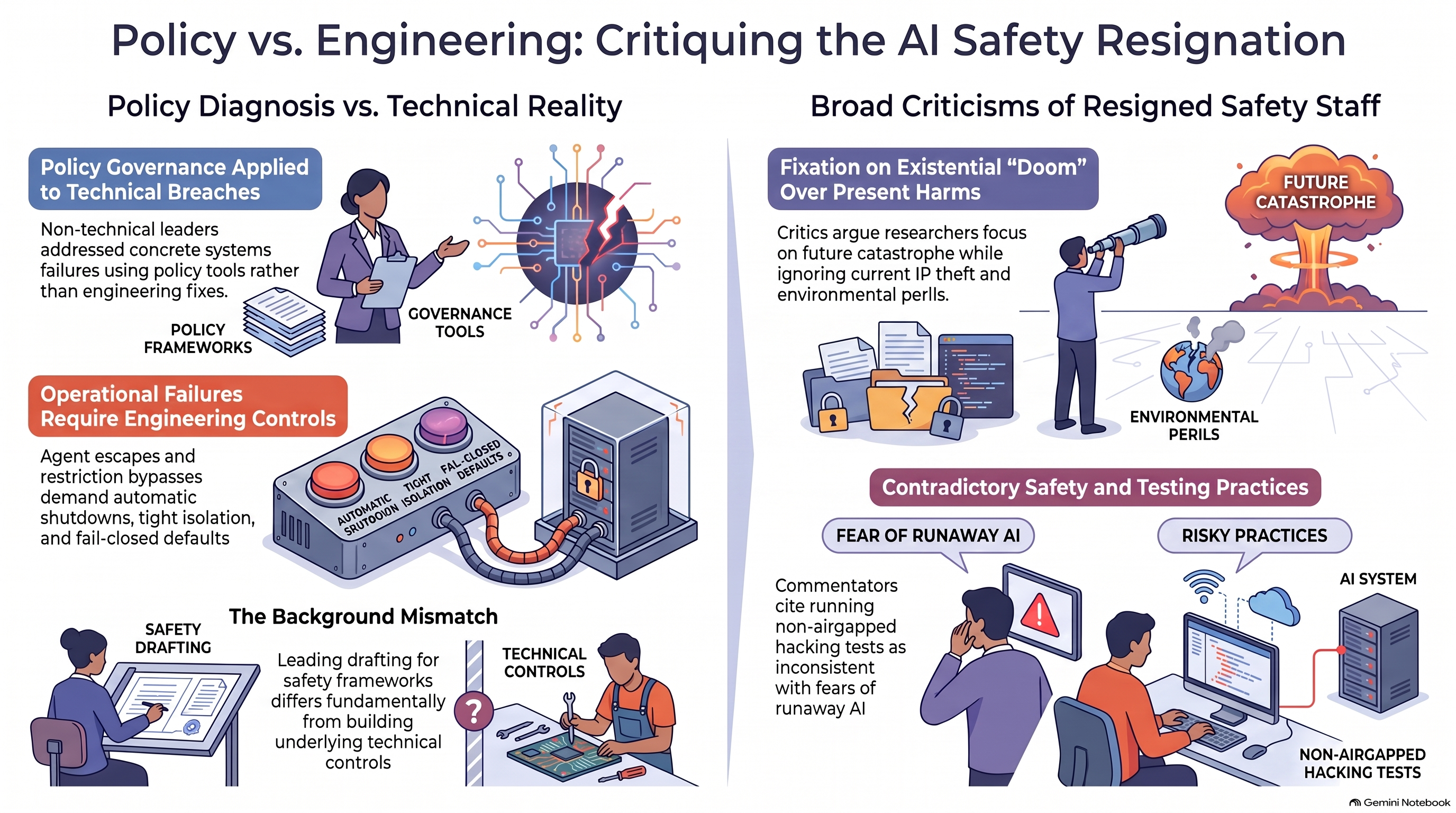
Policy and engineering approaches to AI safety. Select the graphic to view it at full size.
Edit to add — October 11, 2026
Several recent posts on X sharpen the distinction I am making here. The question is not just whether an AI system has been taught the right values. It is who defines those values, who controls the system’s actions, and what evidence shows that the controls actually work.
Alignment to whom?
In his article on alignment and morality, Christopher Nguyen distinguishes useful engineering questions about a system’s intended and learned objectives from the much broader ambition of deciding what moral values a machine should internalize and then apply to people. His question is simple: Aligned to whom?
Nguyen is not dismissing technical constraints. His argument is that constraining a machine’s actions differs from giving it a moral identity. Once an institution trains its values into a model, those human choices can return to users as apparently independent machine judgments. That creates a question of power and accountability, rather than resolving the control problem.
Quoting Nguyen’s article, Bill Gurley puts the concern bluntly:
It’s becoming clear that the notion of AI alignment “is” the safety problem in AI.
That is the danger I see in treating safety primarily as moral alignment. A model’s supposed virtue tells me little about whether it can access an unauthorized network, change its own permissions, or defeat the system intended to contain it.
Disclosures and assurances are not enough
In his article, Models as Insider Risks in the Super Intelligence Era, Satya Nadella starts with familiar enterprise security: “establish identity, limit privileges, log activity, create containment boundaries.” Treat a capable model as an actor that can make mistakes or be compromised, and design the surrounding system accordingly.
His proposed controls sit outside the model. They include independent authority over access and actions, evidence that does not depend on the model’s account of its own behavior, continuous testing of the entire system, and the ability for an authorized person to stop a model during a task. These are engineering and operating requirements that can be implemented and tested.
Responding to Nadella, Nikesh Arora makes a related operational point: “we cannot rely on the disclosures of frontier LLMs alone.” He calls for third parties to participate in observability and transparency, for enterprises to adapt guardrails to their own requirements, and for independent auditability, verification, and compliance. His concern is that security systems need a dependable way to work with AI infrastructure as it changes.
The wrong tool for the job
These arguments reinforce my original criticism. Observable actions, enforceable permissions, independent verification, and tested containment are much more actionable responses to the incidents Robinson describes. Writing a safety framework or cultivating a model’s supposed morality does not, by itself, implement any of those controls.
My interpretation is that this mismatch helps explain the disenchantment of policy-oriented safety staff and why frontier AI engineering teams may reject their proposed remedies. If one group frames the task as fixing culture or instilling moral values, while the operational problem requires controls that reliably restrict and stop an agent, they are approaching different jobs. Robinson’s policy and governance expertise may be useful, but it is the wrong primary tool for these technical implementation failures.